Control
Client-owned by design
The user decides whether anything from the app is shown, summarized or discussed. Orso is designed as a private reflection space first.


Orso is a wellbeing app for iPhone that helps people track mood, context and patterns between sessions. It is designed to sit next to therapy and medical care, not to replace them.
The app is developed by a single independent creator and has not yet been built in formal collaboration with healthcare professionals. It is not a medical device and it does not provide diagnosis or treatment.
Orso is intentionally positioned as a personal wellbeing companion. It can help people notice patterns, remember relevant examples and arrive with clearer context, while keeping control in the hands of the client.
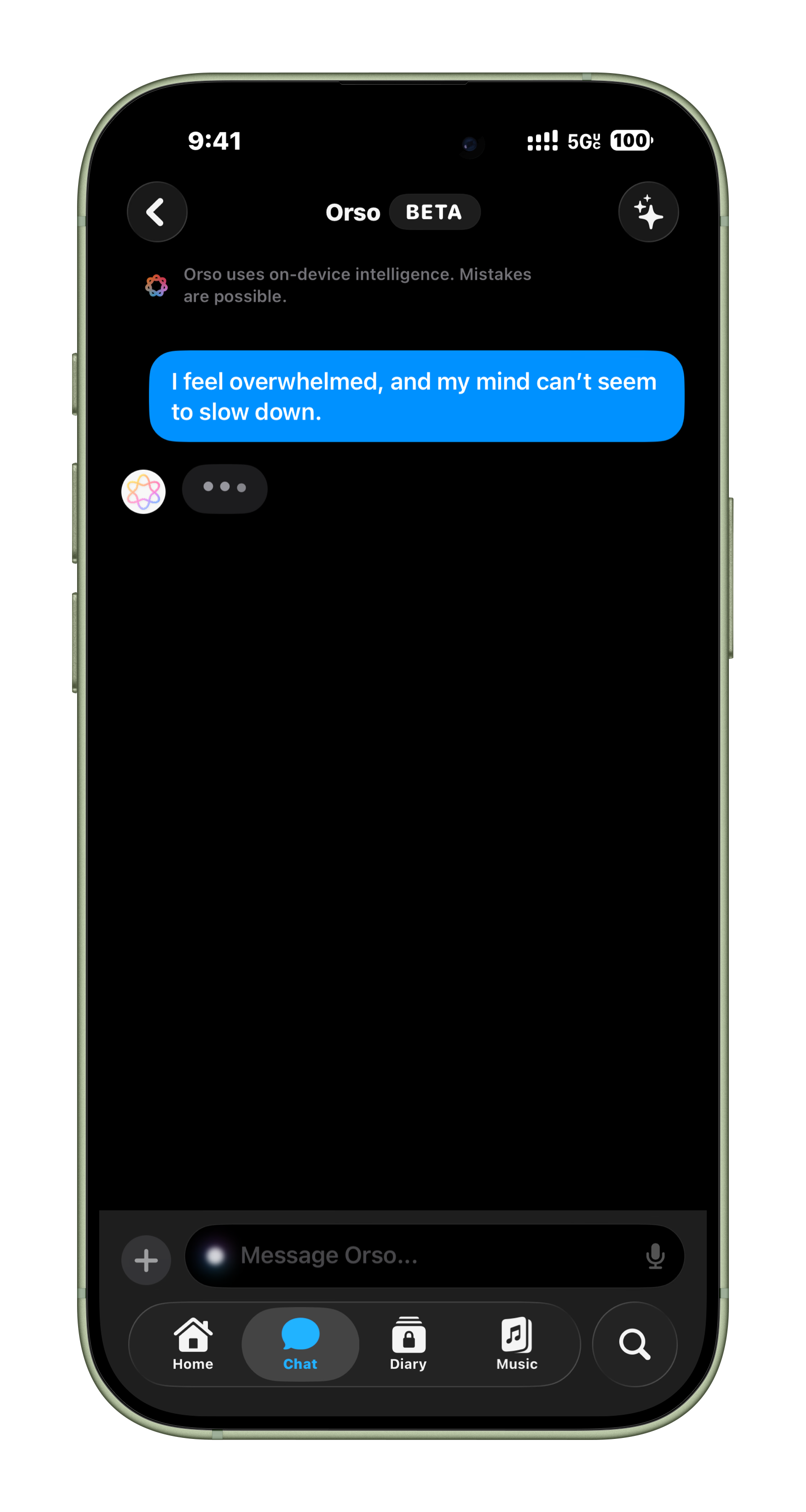
Orso can sit beside therapeutic work as a calmer personal companion for memory, mood and pattern awareness on iPhone.
Orso is designed for people who want a calm place to log mood, energy, sleep and context. Many of them may also work with psychologists, psychotherapists and psychiatrists.
The product is meant to help users notice what is hard to remember later: what happened before a shift in mood, what routines helped, what physical context may have mattered, and which examples might be useful to bring into a session.
It is not built to tell professionals what to conclude. It is built to help clients arrive with a steadier, more structured sense of what they have actually lived through.
Orso can help people notice triggers, connect physical factors such as sleep or activity with mood, and arrive in sessions with recent examples that are easier to describe.
Better recall, better context, and better continuity when a person wants to understand their patterns over time.
From a data perspective, Orso is intentionally simple: logs are stored on the user’s iPhone. No automatic data stream is created between Orso and any professional or institution.
The user decides whether anything from the app is shown, summarized or discussed. Orso is designed as a private reflection space first.
Orso does not automatically report information to clinicians, practices, hospitals or institutions. There is currently no clinician portal.
The product is positioned to sit next to care, not inside the infrastructure of care. That distinction is deliberate.
When a person chooses to share information from Orso, the app can support conversations by helping them arrive with clearer memory, better context and more structured observations.
Orso is positioned as a personal wellbeing companion. It can sit alongside therapeutic work, but it remains client-owned, non-clinical and deliberately simple from a data-sharing perspective.
The long-term vision is to make self-observation easier, more structured and more useful in real life, while preserving privacy and user control.
For professionals, that means Orso may be helpful when a client wants a clearer account of mood, behavior, sleep and context. It does not mean the app should be treated as a clinical source of truth.
Best understood as a client-owned companion that can improve the quality of recall and reflection around care.
Questions from professionals can be sent to contact@orso-assistant.com.